
Fluid particle monitors using the mesh blockage technique measures contamination levels by detecting pressure or flow changes as particles clog a fine mesh screen.
This method is especially effective for analyzing opaque, multi-phase, or aerated fluids that can interfere with optical particle monitor. The results are often reported as an ISO 4406 cleanliness code, an international standard that classifies the fluid’s contamination level.
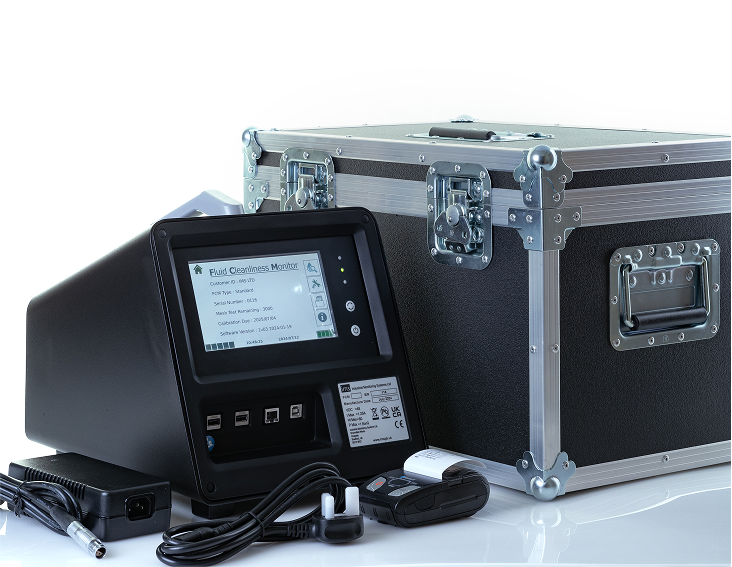
Fluid Particle Monitor
There are two primary types of automatic particle monitor (APCs):
- Light-based counters: These are the most common type for laboratory analysis. A laser beam is passed through a fluid sample, and a photodetector measures the light that is either blocked (light obscuration) or scattered (light scattering) by particles.
- Mesh blockage counters: These are often used for on-site, in-service monitoring, especially when the fluid is dark, contains water, or has entrained air.
Mesh blockage technique
The mesh blockage method, also known as pore blockage, estimates particle counts by measuring the resistance to fluid flow across a fine mesh.
- Constant flow design: The instrument maintains a constant flow rate and measures the increase in pressure drop as particles accumulate on the mesh.
- Constant pressure design: The instrument holds the pressure constant and measures the decay in the flow rate as the mesh becomes blocked.
In both cases, the change in pressure or flow is used to calculate the particle count, which is then reported in an ISO cleanliness code.
- Unaffected by non-homogeneous fluids, free water, or entrained air.
- Suitable for monitoring dark or opaque oils, such as used diesel engine oil, that can be difficult for light-based counters.
- Recognized by international standards, including ISO 21018
ISO 4406 cleanliness codes
ISO 4406 is the international standard for reporting the level of particulate contamination in hydraulic and lubricating fluids.

